Diagnostically acceptable irreversible compression (DAIC) is the amount of lossy compression which can be used on a medical image to produce a result that does not prevent the reader from using the image to make a medical diagnosis. The term was first introduced at a workshop on irreversible compression convened by the European Society of Radiology (ESR) in Palma de Mallorca October 13, 2010, the results of which were reported in a subsequent position paper. == Determination == The "amount of compression" in irreversible compression used to be determined by the compression ratio, where the acceptable minimum is determined by the algorithm (typically JPEG or J2K) and the data type (body part and imaging method). Such a definition is easy to follow, and has been used by medical bodies in 2010 around the world. However, its downside is obvious: the compression ratio tells nothing about the real quality of the image, as different compressors can produce vastly different qualities under the same file size. For example, the JPEG format of 1992 can perform as well as many modern formats given newer techniques exploited in mozjpeg and ISO libjpeg, yet they would be lumped together with the legacy encoders in such a scheme. The image compression community has long used objective quality metrics like SSIM to measure the effects of compression. In the absence of good data regarding SSIM, the ESR review of 2010 concluded that it is still difficult to establish a criterion for whether a particular irreversible compression scheme applied with particular parameters to a particular individual image, or category of images, avoids the introduction of some quantifiable risk of a diagnostic error for any particular diagnostic task. A 2017 study showed that a SSIM variant called 4-G-r (4-component, gradient, structural component of SSIM) best reflects changes in images that affect the decision of radiologists out of 16 SSIM variants. A 2020 study shows that visual information fidelity (VIF), feature similarity index (FSIM), and noise quality metric (NQM) best reflect radiologist preferences out of ten metrics. It also mentions that the original version of SSIM works as poorly as a basic root-mean-square distance (RMSD) for this purpose, a result echoed by the 2017 study. The 4-G-r modification is not tested in the study.
Robotics
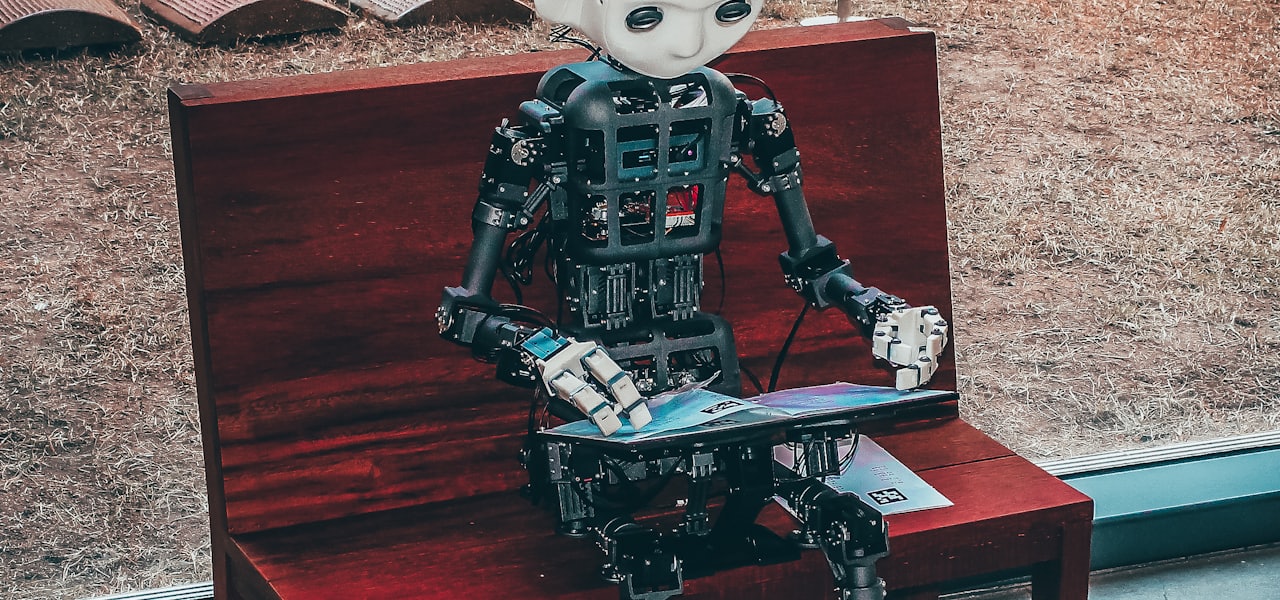
Robotics is the interdisciplinary study and practice of the design, construction, operation, and use of robots. A roboticist is someone who specializes in robotics. Robotics usually combines four aspects of design work: a power source (e.g. a battery), mechanical construction, a control system (electrical circuits), and software (run by remote control or artificial intelligence). The goal of most robotics is to design machines that can assist humans in various fields, such as agriculture, construction, domestic work, food processing, inventory management, manufacturing, medicine, military, mining, space exploration, and transportation. Robots impact humans by displacing workers. Some expect this to occur at an increasing rate, leading to proposed solutions such as basic income. Robotics is itself a lucrative business that creates careers, especially for postgraduates. Roboticists often aim to create machines that seem to interface naturally with humans. The field is under active research and development, with areas of interest including robot kinematics and quantum robotics. == Design == Robotics usually combines four aspects of design work to create a robot: Power source: Potential energy sources include wired electricity, a battery, and/or petrol. Mechanical construction: A physical form or combination of forms is designed to functionally achieve tasks within a given range of environments. This can include locomotive elements such as wheels and caterpillar tracks, as well as hydraulic limbs and manipulators (e.g. hands). Control system: Electrical circuits (utilizing components such as diodes and transistors) are used to run software, govern motor movement, and read sensors. Software: A program is how a robot decides when or how to do something. Robotic programs can be run by remote control, artificial intelligence (AI), or a hybrid of the two. AI programming is an important part of robotic navigation and human–robot interaction. === Power source === Many different types of batteries can be used as a power source. Most are lead–acid batteries, which are safe and have relatively long shelf lives but are rather heavy compared to silver–cadmium batteries, which are much smaller in volume and much more expensive. Designing a battery-powered robot needs to take into account factors such as safety, cycle lifetime, and weight. Generators, often some type of internal combustion engine, can also be used, but are often mechanically complex and inefficient. Additionally, a tether could connect the robot to a power supply, saving weight and space, but requiring a cumbersome cable. Potential power sources include: Flywheel energy storage Hydraulics Nuclear Organic garbage (through anaerobic digestion) Pneumatics (compressed gases) Solar power === Mechanical construction === Actuators are the "muscles" of a robot, the parts which convert stored energy into movement. The most popular actuators are electric motors that rotate a wheel or gear and linear actuators that control factory robots. Most robots use electric motors—often brushed and brushless DC motors in portable robots or AC motors in industrial robots and computer numerical control machines—especially in systems with lighter loads and where the predominant form of motion is rotational. Meanwhile, linear actuators move in and out and often have quicker direction changes, particularly when large forces are needed, such as with industrial robotics. They are typically powered by oil or compressed air, but can also be powered by electricity, usually via a motor and a leadscrew. The mechanical rack and pinion is common. Recent alternatives to DC motors are piezoelectric motors, including ultrasonic motors, in which tiny piezoceramic elements vibrate many thousands of times per second, causing linear or rotary motion. One type uses the vibration of the piezo elements to step the motor in a circle or a straight line; another type uses the piezo elements to vibrate a nut or drive a screw. The advantages of these motors are nanometer resolution, speed, and force for their size. Series elastic actuation (SEA) relies on introducing intentional elasticity between the motor actuator and the load for robust force control. Due to the resultant lower reflected inertia, series elastic actuation improves safety during robot interactions or collisions. Further, it provides energy efficiency and shock absorption (mechanical filtering) while reducing excessive wear on the transmission and other components. This approach has successfully been employed in various robots, particularly advanced manufacturing robots and walking humanoid robots. The controller design of a series elastic actuator is most often performed within the passivity framework as it ensures the safety of interaction with unstructured environments. However, this framework suffers from stringent limitations imposed on the controller, which may impact performance. Pneumatic artificial muscles, also known as air muscles, are special tubes that expand (typically up to 42%) when air is forced inside them; they are used in some robot applications. Muscle wire, also known as shape memory alloy, is a material that contracts (under 5%) when electricity is applied; they have been used for some small robots. Electroactive polymers are a plastic material that can contract substantially (up to 380% activation strain) from electricity and have been used in the facial muscles and arms of humanoid robots, as well as to enable new robots to float, fly, swim or walk. Additionally, elastic carbon nanotubes are a promising experimental artificial muscle technology. The absence of defects in carbon nanotubes enables these filaments to deform elastically by several percent, with energy storage levels of perhaps 10 J/cm3 for metal nanotubes. Human biceps could be replaced with wire of this material measuring 8 millimetres (3⁄8 in) in diameter, feasibly allowing future robots to outperform humans. ==== Locomotion ==== Robots with only one or two wheel(s) can have advantages such as greater efficiency, reduced parts, and navigation through confined areas. A one-wheeled robot balances on a round ball; Carnegie Mellon University's Ballbot is the approximate height and width of a person. Several attempts have also been made to build spherical robots (also known as orb bots or ball bots), which move by spinning a weight inside the ball or rotating outer shells. Two-wheeled balancing robots generally use a gyroscope to detect how much a robot is falling and drive the wheels proportionally up to hundreds of times per second to counterbalance the fall, based on inverted pendulum dynamics. NASA's Robonaut has been mounted to a Segway for a similar effect. Most mobile robots have four wheels or continuous tracks. Six wheels can give better traction in outdoor terrain, while tracks provide even more grip. Tracked wheels are common for outdoor off-road robots, but are difficult to use indoors. A small number of skating robots have been developed, one of which is a multimodal walking and skating device with four legs and unpowered wheels. Several robots have been made that can walk on two legs, but not yet as reliably as a human. Many other robots have been built that walk on more than two legs, being significantly easier. Walking robots could be used for uneven terrains, providing a high degree of mobility and efficiency, but two-legged robots can currently only handle flat floors or perhaps stairs. Some approaches have included: The zero moment point (ZMP) is the algorithm used by robots such as Honda's ASIMO. The robot's onboard computer tries to keep the total inertial forces (the combination of Earth's gravity and the acceleration and deceleration of walking) exactly opposed by the floor reaction force (the force of the floor pushing back on the robot's foot). In this way, the two forces cancel out, leaving no moment (force causing the robot to rotate and fall over). Human observers note that this is not exactly how a human walks, with some describing ASIMO's walk as looking like it needs use the bathroom. ASIMO's walking algorithm utilizes some dynamic balancing, but requires a flat surface. Several robots, built in the 1980s by Marc Raibert at the MIT Leg Laboratory, successfully demonstrated very dynamic walking. Initially, a robot with only one leg, and a very small foot could stay upright simply by hopping. The movement is the same as that of a person on a pogo stick. As the robot falls to one side, it would jump slightly in that direction to catch itself. Soon, the algorithm was generalized to two and four legs. A bipedal robot was demonstrated running and even performing somersaults. A quadruped was also demonstrated which could trot, run, pace, and bound. A more advanced approach is a dynamic balancing algorithm, which constantly monitors the robot's motion and places the feet to maintain stability. This technique has been demonstrated by Anybots' Dexter robot (
Liquid state machine
A liquid state machine (LSM) is a type of reservoir computer that uses a spiking neural network. An LSM consists of a large collection of units (called nodes, or neurons). Each node receives time varying input from external sources (the inputs) as well as from other nodes. Nodes are randomly connected to each other. The recurrent nature of the connections turns the time varying input into a spatio-temporal pattern of activations in the network nodes. The spatio-temporal patterns of activation are read out by linear discriminant units. The soup of recurrently connected nodes will end up computing a large variety of nonlinear functions on the input. Given a large enough variety of such nonlinear functions, it is theoretically possible to obtain linear combinations (using the read out units) to perform whatever mathematical operation is needed to perform a certain task, such as speech recognition or computer vision. The word liquid in the name comes from the analogy drawn to dropping a stone into a still body of water or other liquid. The falling stone will generate ripples in the liquid. The input (motion of the falling stone) has been converted into a spatio-temporal pattern of liquid displacement (ripples). LSMs have been put forward as a way to explain the operation of brains. LSMs are argued to be an improvement over the theory of artificial neural networks because: Circuits are not hard coded to perform a specific task. Continuous time inputs are handled "naturally". Computations on various time scales can be done using the same network. The same network can perform multiple computations. Criticisms of LSMs as used in computational neuroscience are that LSMs don't actually explain how the brain functions. At best they can replicate some parts of brain functionality. There is no guaranteed way to dissect a working network and figure out how or what computations are being performed. There is very little control over the process. == Universal function approximation == If a reservoir has fading memory and input separability, with help of a readout, it can be proven the liquid state machine is a universal function approximator using Stone–Weierstrass theorem.
Genetic programming
Genetic programming (GP) is an evolutionary algorithm, an artificial intelligence technique mimicking natural evolution, which operates on a population of programs. It applies the genetic operators selection according to a predefined fitness measure, mutation and crossover. The crossover operation involves swapping specified parts of selected pairs (parents) to produce new and different offspring that become part of the new generation of programs. Some programs not selected for reproduction are copied from the current generation to the new generation. Mutation involves substitution of some random part of a program with some other random part of a program. Then the selection and other operations are recursively applied to the new generation of programs. Typically, members of each new generation are on average more fit than the members of the previous generation, and the best-of-generation program is often better than the best-of-generation programs from previous generations. Termination of the evolution usually occurs when some individual program reaches a predefined proficiency or fitness level. It may and often does happen that a particular run of the algorithm results in premature convergence to some local maximum that is not a globally optimal or even good solution. Multiple runs (dozens to hundreds) are usually necessary to produce a very good result. It may also be necessary to have a large starting population size and variability of the individuals to avoid pathologies. == History == The first record of the proposal to evolve programs is probably that of Alan Turing in 1950 in "Computing Machinery and Intelligence". There was a gap of 25 years before the publication of John Holland's 'Adaptation in Natural and Artificial Systems' laid out the theoretical and empirical foundations of the science. In 1981, Richard Forsyth demonstrated the successful evolution of small programs, represented as trees, to perform classification of crime scene evidence for the UK Home Office. Although the idea of evolving programs, initially in the computer language Lisp, was current amongst John Holland's students, it was not until they organised the first Genetic Algorithms (GA) conference in Pittsburgh that Nichael Cramer published evolved programs in two specially designed languages, which included the first statement of modern "tree-based" genetic programming (that is, procedural languages organized in tree-based structures and operated on by suitably defined GA-operators). In 1988, John Koza (also a PhD student of John Holland) patented his invention of a GA for program evolution. This was followed by publication in the International Joint Conference on Artificial Intelligence IJCAI-89. Koza followed this with 205 publications on "genetic programming", a term coined by David Goldberg, also a PhD student of John Holland. However, it is the series of 4 books by Koza, starting in 1992 with accompanying videos, that really established GP. Subsequently, there was an enormous expansion of the number of publications with the Genetic Programming Bibliography, surpassing 10,000 entries. In 2010, Koza listed 77 results where genetic programming was human competitive. The departure of GP from the rigid, fixed-length representations typical of early GA models was not entirely without precedent. Early work on variable-length representations laid the groundwork. One notable example is messy genetic algorithms, which introduced irregular, variable-length chromosomes to address building block disruption and positional bias in standard GAs. Another precursor was robot trajectory programming, where genome representations encoded program instructions for robotic movements—structures inherently variable in length. Even earlier, unfixed-length representations were proposed in a doctoral dissertation by Cavicchio, who explored adaptive search using simulated evolution. His work provided foundational ideas for flexible program structures. In 1996, Koza started the annual Genetic Programming conference, which was followed in 1998 by the annual EuroGP conference, and the first book in a GP series edited by Koza. 1998 also saw the first GP textbook. GP continued to flourish, leading to the first specialist GP journal and three years later (2003) the annual Genetic Programming Theory and Practice (GPTP) workshop was established by Rick Riolo. Genetic programming papers continue to be published at a diversity of conferences and associated journals. Today there are nineteen GP books including several for students. === Foundational work in GP === Early work that set the stage for current genetic programming research topics and applications is diverse, and includes software synthesis and repair, predictive modeling, data mining, financial modeling, soft sensors, design, and image processing. Applications in some areas, such as design, often make use of intermediate representations, such as Fred Gruau's cellular encoding. Industrial uptake has been significant in several areas including finance, the chemical industry, bioinformatics and the steel industry. == Methods == === Program representation === GP evolves computer programs, traditionally represented in memory as tree structures. Trees can be easily evaluated in a recursive manner. Every internal node has an operator function and every terminal node has an operand, making mathematical expressions easy to evolve and evaluate. Thus traditionally GP favors the use of programming languages that naturally embody tree structures (for example, Lisp; other functional programming languages are also suitable). Non-tree representations have been suggested and successfully implemented, such as linear genetic programming, which perhaps suits the more traditional imperative languages. The commercial GP software Discipulus uses automatic induction of binary machine code ("AIM") to achieve better performance. μGP uses directed multigraphs to generate programs that fully exploit the syntax of a given assembly language. Multi expression programming uses three-address code for encoding solutions. Other program representations on which significant research and development have been conducted include programs for stack-based virtual machines, and sequences of integers that are mapped to arbitrary programming languages via grammars. Cartesian genetic programming is another form of GP, which uses a graph representation instead of the usual tree based representation to encode computer programs. Most representations have structurally noneffective code (introns). Such non-coding genes may seem to be useless because they have no effect on the performance of any one individual. However, they alter the probabilities of generating different offspring under the variation operators, and thus alter the individual's variational properties. Experiments seem to show faster convergence when using program representations that allow such non-coding genes, compared to program representations that do not have any non-coding genes. Instantiations may have both trees with introns and those without; the latter are called canonical trees. Special canonical crossover operators are introduced that maintain the canonical structure of parents in their children. === Initialisation === The methods for creation of the initial population include: Grow creates the individuals sequentially. Every GP tree is created starting from the root, creating functional nodes with children as well as terminal nodes up to a certain depth. Full is similar to the Grow. The difference is that all brunches in a tree are of same predetermined depth. Ramped half-and-half creates a population consisting of m d − 1 {\displaystyle md-1} parts and a maximum depth of m d {\displaystyle md} for its trees. The first part has a maximum depth of 2, second of 3 and so on up to the m d − 1 {\displaystyle md-1} -th part with maximum depth m d {\displaystyle md} . Half of every part is created by Grow, while the other part is created by Full. === Selection === Selection is a process whereby certain individuals are selected from the current generation that would serve as parents for the next generation. The individuals are selected probabilistically such that the better performing individuals have a higher chance of getting selected. The most commonly used selection method in GP is tournament selection, although other methods such as fitness proportionate selection, lexicase selection, and others have been demonstrated to perform better for many GP problems. Elitism, which involves seeding the next generation with the best individual (or best n individuals) from the current generation, is a technique sometimes employed to avoid regression. === Crossover === In genetic programming two fit individuals are chosen from the population to be parents for one or two children. In tree genetic programming, these parents are represented as inverted lisp like trees, with their root nodes at the top. In subtree cro
Vapnik–Chervonenkis theory
Vapnik–Chervonenkis theory (also known as VC theory) was developed during 1960–1990 by Vladimir Vapnik and Alexey Chervonenkis. The theory is a form of computational learning theory, which attempts to explain the learning process from a statistical point of view. == Introduction == VC theory covers at least four parts (as explained in The Nature of Statistical Learning Theory): Theory of consistency of learning processes What are (necessary and sufficient) conditions for consistency of a learning process based on the empirical risk minimization principle? Nonasymptotic theory of the rate of convergence of learning processes How fast is the rate of convergence of the learning process? Theory of controlling the generalization ability of learning processes How can one control the rate of convergence (the generalization ability) of the learning process? Theory of constructing learning machines How can one construct algorithms that can control the generalization ability? VC Theory is a major subbranch of statistical learning theory. One of its main applications in statistical learning theory is to provide generalization conditions for learning algorithms. From this point of view, VC theory is related to stability, which is an alternative approach for characterizing generalization. In addition, VC theory and VC dimension are instrumental in the theory of empirical processes, in the case of processes indexed by VC classes. Arguably these are the most important applications of the VC theory, and are employed in proving generalization. Several techniques will be introduced that are widely used in the empirical process and VC theory. The discussion is mainly based on the book Weak Convergence and Empirical Processes: With Applications to Statistics. == Overview of VC theory in empirical processes == === Background on empirical processes === Let ( X , A ) {\displaystyle ({\mathcal {X}},{\mathcal {A}})} be a measurable space. For any measure Q {\displaystyle Q} on ( X , A ) {\displaystyle ({\mathcal {X}},{\mathcal {A}})} , and any measurable functions f : X → R {\displaystyle f:{\mathcal {X}}\to \mathbf {R} } , define Q f = ∫ f d Q {\displaystyle Qf=\int fdQ} Measurability issues will be ignored here, for more technical detail see. Let F {\displaystyle {\mathcal {F}}} be a class of measurable functions f : X → R {\displaystyle f:{\mathcal {X}}\to \mathbf {R} } and define: ‖ Q ‖ F = sup { | Q f | : f ∈ F } . {\displaystyle \|Q\|_{\mathcal {F}}=\sup\{\vert Qf\vert \ :\ f\in {\mathcal {F}}\}.} Let X 1 , … , X n {\displaystyle X_{1},\ldots ,X_{n}} be independent, identically distributed random elements of ( X , A ) {\displaystyle ({\mathcal {X}},{\mathcal {A}})} . Then define the empirical measure P n = n − 1 ∑ i = 1 n δ X i , {\displaystyle \mathbb {P} _{n}=n^{-1}\sum _{i=1}^{n}\delta _{X_{i}},} where δ here stands for the Dirac measure. The empirical measure induces a map F → R {\displaystyle {\mathcal {F}}\to \mathbf {R} } given by: f ↦ P n f = 1 n ( f ( X 1 ) + . . . + f ( X n ) ) {\displaystyle f\mapsto \mathbb {P} _{n}f={\frac {1}{n}}(f(X_{1})+...+f(X_{n}))} Now suppose P is the underlying true distribution of the data, which is unknown. Empirical Processes theory aims at identifying classes F {\displaystyle {\mathcal {F}}} for which statements such as the following hold: uniform law of large numbers: ‖ P n − P ‖ F → n 0 , {\displaystyle \|\mathbb {P} _{n}-P\|_{\mathcal {F}}{\underset {n}{\to }}0,} That is, as n → ∞ {\displaystyle n\to \infty } , | 1 n ( f ( X 1 ) + . . . + f ( X n ) ) − ∫ f d P | → 0 {\displaystyle \left|{\frac {1}{n}}(f(X_{1})+...+f(X_{n}))-\int fdP\right|\to 0} uniformly for all f ∈ F {\displaystyle f\in {\mathcal {F}}} . uniform central limit theorem: G n = n ( P n − P ) ⇝ G , in ℓ ∞ ( F ) {\displaystyle \mathbb {G} _{n}={\sqrt {n}}(\mathbb {P} _{n}-P)\rightsquigarrow \mathbb {G} ,\quad {\text{in }}\ell ^{\infty }({\mathcal {F}})} In the former case F {\displaystyle {\mathcal {F}}} is called Glivenko–Cantelli class, and in the latter case (under the assumption ∀ x , sup f ∈ F | f ( x ) − P f | < ∞ {\displaystyle \forall x,\sup \nolimits _{f\in {\mathcal {F}}}\vert f(x)-Pf\vert <\infty } ) the class F {\displaystyle {\mathcal {F}}} is called Donsker or P-Donsker. A Donsker class is Glivenko–Cantelli in probability by an application of Slutsky's theorem. These statements are true for a single f {\displaystyle f} , by standard LLN, CLT arguments under regularity conditions, and the difficulty in the Empirical Processes comes in because joint statements are being made for all f ∈ F {\displaystyle f\in {\mathcal {F}}} . Intuitively then, the set F {\displaystyle {\mathcal {F}}} cannot be too large, and as it turns out that the geometry of F {\displaystyle {\mathcal {F}}} plays a very important role. One way of measuring how big the function set F {\displaystyle {\mathcal {F}}} is to use the so-called covering numbers. The covering number N ( ε , F , ‖ ⋅ ‖ ) {\displaystyle N(\varepsilon ,{\mathcal {F}},\|\cdot \|)} is the minimal number of balls { g : ‖ g − f ‖ < ε } {\displaystyle \{g:\|g-f\|<\varepsilon \}} needed to cover the set F {\displaystyle {\mathcal {F}}} (here it is obviously assumed that there is an underlying norm on F {\displaystyle {\mathcal {F}}} ). The entropy is the logarithm of the covering number. Two sufficient conditions are provided below, under which it can be proved that the set F {\displaystyle {\mathcal {F}}} is Glivenko–Cantelli or Donsker. A class F {\displaystyle {\mathcal {F}}} is P-Glivenko–Cantelli if it is P-measurable with envelope F such that P ∗ F < ∞ {\displaystyle P^{\ast }F<\infty } and satisfies: ∀ ε > 0 sup Q N ( ε ‖ F ‖ Q , F , L 1 ( Q ) ) < ∞ . {\displaystyle \forall \varepsilon >0\quad \sup \nolimits _{Q}N(\varepsilon \|F\|_{Q},{\mathcal {F}},L_{1}(Q))<\infty .} The next condition is a version of Dudley's theorem. If F {\displaystyle {\mathcal {F}}} is a class of functions such that ∫ 0 ∞ sup Q log N ( ε ‖ F ‖ Q , 2 , F , L 2 ( Q ) ) d ε < ∞ {\displaystyle \int _{0}^{\infty }\sup \nolimits _{Q}{\sqrt {\log N\left(\varepsilon \|F\|_{Q,2},{\mathcal {F}},L_{2}(Q)\right)}}d\varepsilon <\infty } then F {\displaystyle {\mathcal {F}}} is P-Donsker for every probability measure P such that P ∗ F 2 < ∞ {\displaystyle P^{\ast }F^{2}<\infty } . In the last integral, the notation means ‖ f ‖ Q , 2 = ( ∫ | f | 2 d Q ) 1 2 {\displaystyle \|f\|_{Q,2}=\left(\int |f|^{2}dQ\right)^{\frac {1}{2}}} . === Symmetrization === The majority of the arguments about how to bound the empirical process rely on symmetrization, maximal and concentration inequalities, and chaining. Symmetrization is usually the first step of the proofs, and since it is used in many machine learning proofs on bounding empirical loss functions (including the proof of the VC inequality which is discussed in the next section). It is presented here: Consider the empirical process: f ↦ ( P n − P ) f = 1 n ∑ i = 1 n ( f ( X i ) − P f ) {\displaystyle f\mapsto (\mathbb {P} _{n}-P)f={\dfrac {1}{n}}\sum _{i=1}^{n}(f(X_{i})-Pf)} Turns out that there is a connection between the empirical and the following symmetrized process: f ↦ P n 0 f = 1 n ∑ i = 1 n ε i f ( X i ) {\displaystyle f\mapsto \mathbb {P} _{n}^{0}f={\dfrac {1}{n}}\sum _{i=1}^{n}\varepsilon _{i}f(X_{i})} The symmetrized process is a Rademacher process, conditionally on the data X i {\displaystyle X_{i}} . Therefore, it is a sub-Gaussian process by Hoeffding's inequality. Lemma (Symmetrization). For every nondecreasing, convex Φ: R → R and class of measurable functions F {\displaystyle {\mathcal {F}}} , E Φ ( ‖ P n − P ‖ F ) ≤ E Φ ( 2 ‖ P n 0 ‖ F ) {\displaystyle \mathbb {E} \Phi (\|\mathbb {P} _{n}-P\|_{\mathcal {F}})\leq \mathbb {E} \Phi \left(2\left\|\mathbb {P} _{n}^{0}\right\|_{\mathcal {F}}\right)} The proof of the Symmetrization lemma relies on introducing independent copies of the original variables X i {\displaystyle X_{i}} (sometimes referred to as a ghost sample) and replacing the inner expectation of the LHS by these copies. After an application of Jensen's inequality different signs could be introduced (hence the name symmetrization) without changing the expectation. The proof can be found below because of its instructive nature. The same proof method can be used to prove the Glivenko–Cantelli theorem. A typical way of proving empirical CLTs, first uses symmetrization to pass the empirical process to P n 0 {\displaystyle \mathbb {P} _{n}^{0}} and then argue conditionally on the data, using the fact that Rademacher processes are simple processes with nice properties. === VC Connection === It turns out that there is a fascinating connection between certain combinatorial properties of the set F {\displaystyle {\mathcal {F}}} and the entropy numbers. Uniform covering numbers can be controlled by the notion of Vapnik–Chervonenkis classes of sets – or shortly VC sets. Consider a collection C {\displaystyle {\mathcal {C}}} of subsets of the sample space X {\displaystyle
Fabric computing
Fabric computing or unified computing involves constructing a computing fabric consisting of interconnected nodes that look like a weave or a fabric when seen collectively from a distance. Usually the phrase refers to a consolidated high-performance computing system consisting of loosely coupled storage, networking and parallel processing functions linked by high bandwidth interconnects (such as 10 Gigabit Ethernet and InfiniBand) but the term has also been used to describe platforms such as the Azure Services Platform and grid computing in general (where the common theme is interconnected nodes that appear as a single logical unit). The fundamental components of fabrics are "nodes" (processor(s), memory, and/or peripherals) and "links" (functional connections between nodes). While the term "fabric" has also been used in association with storage area networks and with switched fabric networking, the introduction of compute resources provides a complete "unified" computing system. Other terms used to describe such fabrics include "unified fabric", "data center fabric" and "unified data center fabric". Ian Foster, director of the Computation Institute at the Argonne National Laboratory and University of Chicago suggested in 2007 that grid computing "fabrics" were "poised to become the underpinning for next-generation enterprise IT architectures and be used by a much greater part of many organizations". == History == While the term has been in use since the mid to late 1990s the growth of cloud computing and Cisco's evangelism of unified data center fabrics followed by unified computing (an evolutionary data center architecture whereby blade servers are integrated or unified with supporting network and storage infrastructure) starting March 2009 has renewed interest in the technology. There have been mixed reactions to Cisco's architecture, particularly from rivals who claim that these proprietary systems will lock out other vendors. Analysts claim that this "ambitious new direction" is "a big risk" as companies such as IBM and HP who have previously partnered with Cisco on data center projects (accounting for $2–3bn of Cisco's annual revenue) are now competing with them. In 2007, Wombat Financial Software launched the "Wombat Data Fabric," the first commercial off-the-shelf software platform providing high performance / low-latency RDMA-based messaging across an Infiniband switch. == Key characteristics == The main advantages of fabrics are that massive concurrent processing combined with a huge, tightly coupled address space makes it possible to solve huge computing problems (such as those presented by delivery of cloud computing services); and that they are both scalable and able to be dynamically reconfigured. Challenges include a non-linearly degrading performance curve, whereby adding resources does not linearly increase performance which is a common problem with parallel computing and maintaining security. == Companies == As of 2015 companies offering unified or fabric computing systems include Avaya, Brocade, Cisco, Dell, Egenera, HPE, IBM, Liquid Computing Corporation, TIBCO, Unisys, and Xsigo Systems.
Neural cryptography
Neural cryptography is a branch of cryptography dedicated to analyzing the application of stochastic algorithms, especially artificial neural network algorithms, for use in encryption and cryptanalysis. == Definition == Artificial neural networks are well known for their ability to selectively explore the solution space of a given problem. This feature finds a natural niche of application in the field of cryptanalysis. At the same time, neural networks offer a new approach to attack ciphering algorithms based on the principle that any function could be reproduced by a neural network, which is a powerful proven computational tool that can be used to find the inverse-function of any cryptographic algorithm. The ideas of mutual learning, self learning, and stochastic behavior of neural networks and similar algorithms can be used for different aspects of cryptography, like public-key cryptography, solving the key distribution problem using neural network mutual synchronization, hashing or generation of pseudo-random numbers. Another idea is the ability of a neural network to separate space in non-linear pieces using "bias". It gives different probabilities of activating the neural network or not. This is very useful in the case of Cryptanalysis. Two names are used to design the same domain of research: Neuro-Cryptography and Neural Cryptography. The first work that it is known on this topic can be traced back to 1995 in an IT Master Thesis. == Applications == In 1995, Sebastien Dourlens applied neural networks to cryptanalyze DES by allowing the networks to learn how to invert the S-tables of the DES. The bias in DES studied through Differential Cryptanalysis by Adi Shamir is highlighted. The experiment shows about 50% of the key bits can be found, allowing the complete key to be found in a short time. Hardware application with multi micro-controllers have been proposed due to the easy implementation of multilayer neural networks in hardware. One example of a public-key protocol is given by Khalil Shihab . He describes the decryption scheme and the public key creation that are based on a backpropagation neural network. The encryption scheme and the private key creation process are based on Boolean algebra. This technique has the advantage of small time and memory complexities. A disadvantage is the property of backpropagation algorithms: because of huge training sets, the learning phase of a neural network is very long. Therefore, the use of this protocol is only theoretical so far. == Neural key exchange protocol == The most used protocol for key exchange between two parties A and B in the practice is Diffie–Hellman key exchange protocol. Neural key exchange, which is based on the synchronization of two tree parity machines, should be a secure replacement for this method. Synchronizing these two machines is similar to synchronizing two chaotic oscillators in chaos communications. === Tree parity machine === The tree parity machine is a special type of multi-layer feedforward neural network. It consists of one output neuron, K hidden neurons and K×N input neurons. Inputs to the network take three values: x i j ∈ { − 1 , 0 , + 1 } {\displaystyle x_{ij}\in \left\{-1,0,+1\right\}} The weights between input and hidden neurons take the values: w i j ∈ { − L , . . . , 0 , . . . , + L } {\displaystyle w_{ij}\in \left\{-L,...,0,...,+L\right\}} Output value of each hidden neuron is calculated as a sum of all multiplications of input neurons and these weights: σ i = sgn ( ∑ j = 1 N w i j x i j ) {\displaystyle \sigma _{i}=\operatorname {sgn}(\sum _{j=1}^{N}w_{ij}x_{ij})} Signum is a simple function, which returns −1,0 or 1: sgn ( x ) = { − 1 if x < 0 , 0 if x = 0 , 1 if x > 0. {\displaystyle \operatorname {sgn}(x)={\begin{cases}-1&{\text{if }}x<0,\\0&{\text{if }}x=0,\\1&{\text{if }}x>0.\end{cases}}} If the scalar product is 0, the output of the hidden neuron is mapped to −1 in order to ensure a binary output value. The output of neural network is then computed as the multiplication of all values produced by hidden elements: τ = ∏ i = 1 K σ i {\displaystyle \tau =\prod _{i=1}^{K}\sigma _{i}} Output of the tree parity machine is binary. === Protocol === Each party (A and B) uses its own tree parity machine. Synchronization of the tree parity machines is achieved in these steps Initialize random weight values Execute these steps until the full synchronization is achieved Generate random input vector X Compute the values of the hidden neurons Compute the value of the output neuron Compare the values of both tree parity machines Outputs are the same: one of the suitable learning rules is applied to the weights Outputs are different: go to 2.1 After the full synchronization is achieved (the weights wij of both tree parity machines are same), A and B can use their weights as keys. This method is known as a bidirectional learning. One of the following learning rules can be used for the synchronization: Hebbian learning rule: w i + = g ( w i + σ i x i Θ ( σ i τ ) Θ ( τ A τ B ) ) {\displaystyle w_{i}^{+}=g(w_{i}+\sigma _{i}x_{i}\Theta (\sigma _{i}\tau )\Theta (\tau ^{A}\tau ^{B}))} Anti-Hebbian learning rule: w i + = g ( w i − σ i x i Θ ( σ i τ ) Θ ( τ A τ B ) ) {\displaystyle w_{i}^{+}=g(w_{i}-\sigma _{i}x_{i}\Theta (\sigma _{i}\tau )\Theta (\tau ^{A}\tau ^{B}))} Random walk: w i + = g ( w i + x i Θ ( σ i τ ) Θ ( τ A τ B ) ) {\displaystyle w_{i}^{+}=g(w_{i}+x_{i}\Theta (\sigma _{i}\tau )\Theta (\tau ^{A}\tau ^{B}))} Where: Θ ( a , b ) = 0 {\displaystyle \Theta (a,b)=0} if a ≠ b {\displaystyle a\neq b} otherwise Θ ( a , b ) = 1 {\displaystyle \Theta (a,b)=1} And: g ( x ) {\displaystyle g(x)} is a function that keeps the w i {\displaystyle w_{i}} in the range { − L , − L + 1 , . . . , 0 , . . . , L − 1 , L } {\displaystyle \{-L,-L+1,...,0,...,L-1,L\}} === Attacks and security of this protocol === In every attack it is considered, that the attacker E can eavesdrop messages between the parties A and B, but does not have an opportunity to change them. ==== Brute force ==== To provide a brute force attack, an attacker has to test all possible keys (all possible values of weights wij). By K hidden neurons, K×N input neurons and boundary of weights L, this gives (2L+1)KN possibilities. For example, the configuration K = 3, L = 3 and N = 100 gives us 310253 key possibilities, making the attack impossible with today's computer power. ==== Learning with own tree parity machine ==== One of the basic attacks can be provided by an attacker, who owns the same tree parity machine as the parties A and B. He wants to synchronize his tree parity machine with these two parties. In each step there are three situations possible: Output(A) ≠ Output(B): None of the parties updates its weights. Output(A) = Output(B) = Output(E): All the three parties update weights in their tree parity machines. Output(A) = Output(B) ≠ Output(E): Parties A and B update their tree parity machines, but the attacker can not do that. Because of this situation his learning is slower than the synchronization of parties A and B. It has been proven, that the synchronization of two parties is faster than learning of an attacker. It can be improved by increasing of the synaptic depth L of the neural network. That gives this protocol enough security and an attacker can find out the key only with small probability. ==== Other attacks ==== For conventional cryptographic systems, we can improve the security of the protocol by increasing of the key length. In the case of neural cryptography, we improve it by increasing of the synaptic depth L of the neural networks. Changing this parameter increases the cost of a successful attack exponentially, while the effort for the users grows polynomially. Therefore, breaking the security of neural key exchange belongs to the complexity class NP. Alexander Klimov, Anton Mityaguine, and Adi Shamir say that the original neural synchronization scheme can be broken by at least three different attacks—geometric, probabilistic analysis, and using genetic algorithms. Even though this particular implementation is insecure, the ideas behind chaotic synchronization could potentially lead to a secure implementation. === Permutation parity machine === The permutation parity machine is a binary variant of the tree parity machine. It consists of one input layer, one hidden layer and one output layer. The number of neurons in the output layer depends on the number of hidden units K. Each hidden neuron has N binary input neurons: x i j ∈ { 0 , 1 } {\displaystyle x_{ij}\in \left\{0,1\right\}} The weights between input and hidden neurons are also binary: w i j ∈ { 0 , 1 } {\displaystyle w_{ij}\in \left\{0,1\right\}} Output value of each hidden neuron is calculated as a sum of all exclusive disjunctions (exclusive or) of input neurons and these weights: σ i = θ N ( ∑ j = 1 N w i j ⊕ x i j ) {\displaystyle \sigma _{i}=\theta _{N}(\sum _{j=1}^{N}w_{ij}\oplus x_{ij})} (⊕ means XOR). Th